IT’S LILY TIME

s

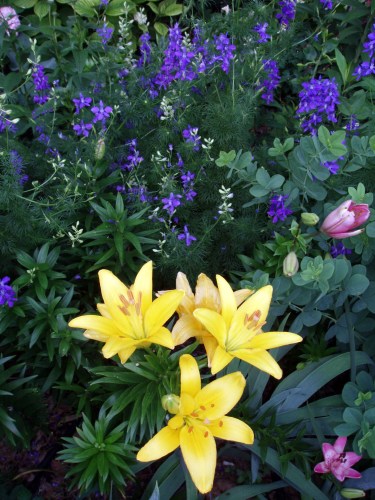
Conca d'Or Orienpet Lily Bud & Bloom

It happens every year.

Just like clockwork.

About the time the sky fills with fireworks

Oriental lilies light up my garden.

They should nick name them 4th of July lilies!

Oriental lilies are tall

5’ – 7 ‘ tall

And fragrant.

Intoxicatingly fragrant.

You’ll notice the scent just by walking near them.

And beautiful.

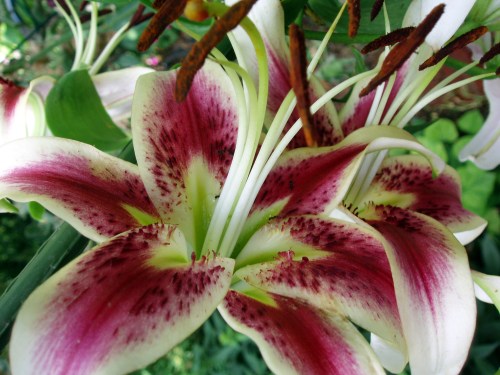
You will recognize two as florist favorites.

The pure white Casa Blanca


Casa Blanca Lily

And hot pink Stargazer are frequent visitors in bouquets and arrangement.


Stargazer Lily

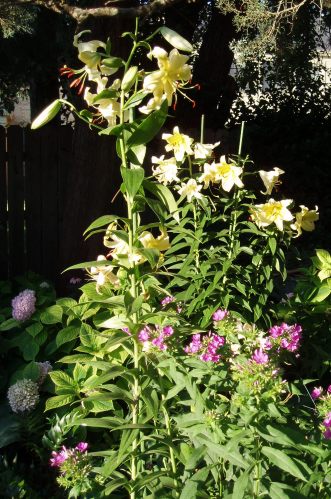
Showing off in my garden this year is a lily of unknown lineage.

I know – I planted it.

But I’m not good at record keeping.

I’ve looked in the catalog and can’t seem to figure out what I ordered.

My best guess is that it’s actually an Orienpet Lily.

That’s a cross between Oriental Lilies and Chinese Trumpet Lilies.

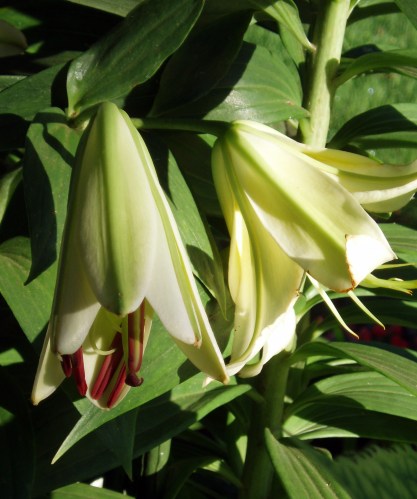
Possibly it’s named Conca d’Or

 Conca d'Or Orienpet Lily

It’s a lemon yellow.

One catalog described it as lemon-meringue pie.

Sounds good to me!

Since Orientals bloom in the heat of the summer they like to live in the shade.

You can give them some morning sunshine but please not in the afternoon.

I learned this the hard way.

The first time I planted Stargazers I ended up covering them with a tea towel every afternoon to keep them blooming a few days longer.

Can’t believe I actually just admitted doing that!

Stems can have up to a dozen or so buds.

Buds will open from the bottom to the top of the stem over a couple of weeks.

It’s not a long bloom period but it’s worth it.

Years ago we took Elliott on an “urban vacation”.

Boston was our destination.

I’d always wanted to see the Boston Pops on the banks of the Charles River on the 4th.

The trip was great – a memorable family lore kind of trip.

But..all the Stargazers bloomed and finished while we were gone.

So sad.

Another great feature of these beauties is that they don’t take up much space.

They grow straight up so you can fit them in anywhere.

But since they will have completely disappeared by the time you get ready to plant bulbs in the fall it’s important that you mark the empty places now.

I use bricks.

Just place a brick or two any place you think would make a good home for lilies.

That way you won’t have to guess or try to remember.

The worst sound in the garden is the sound of a lily bulb being sliced in half by a shovel.

I know.

So this year when the bulb catalogs start arriving – I’ve actually already gotten one – look at Oriental lilies and their cousin the Orienpets.


I have 4 Aloha Rose bushes.

They are a hybrid.

I knew better but got sucked in by the glorious peachy pink blooms.

For the past three years they have been plagued by a tiny bug that sucks the life out of the blooms – thrips – I think.

I’ve tried everything – to no avail.

Last week at the Farmers Market I was spinning my tale of woe to Kate who is an excellent gardener.

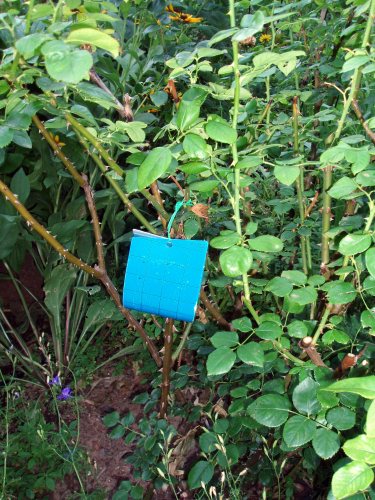
She said a friend tried “blue sticky traps”.

Found them and installed them this week.

Blue Sticky Trap on Aloha Rose Bush - Goodbye Thrip

Hope they work since they are not the prettiest addition to my garden.

Another great reason to go to your local farmers market this weekend.

Advise!

As you garden in this tough heat remember to drink tons of water and most importantly…..follow the shade.


Enjoy,

Gail

P.S.    the Dahlias are coming!!!


4 Comments

Filed under Orienpet Lilies, Oriental Lilies, Uncategorized

TRANSITIONS

There comes a time in the garden

When things change.

It’s a subtle change most years.

But you know it’s coming.

With this week came the transition from spring to summer.

(Although the heat dome seems to have confused us a bit.)

Nature is so wise.

Spring flowers can survive cool or even cold weather.

But not heat.

A hotter than usual spring means the flowers come and go quickly.

I don’t like it when that happens.

Summer flowers can take the heat.

They bask in it.

So nature in her wisdom gave us summer flowers for those hot days.

They begin their reign around the first day of summer.

The work horses of the summer garden are

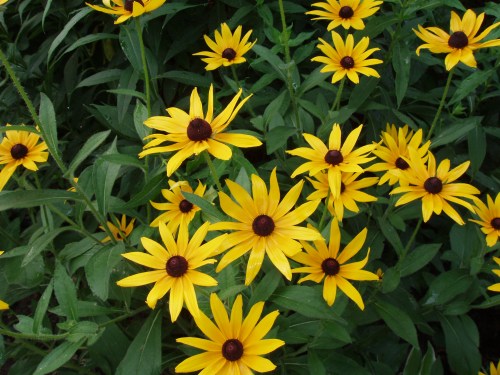
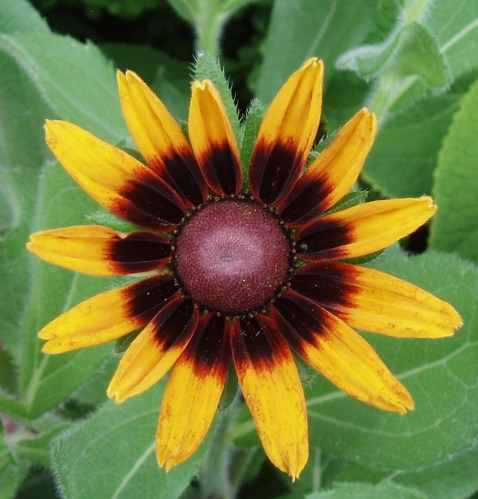
Gloriosa Daisies  (Rudbeckia)

Gloriosa Daisies - Rudbeckia

Purple Coneflowers  (Echinacea)

Purple Coneflowers courtesy of Debra

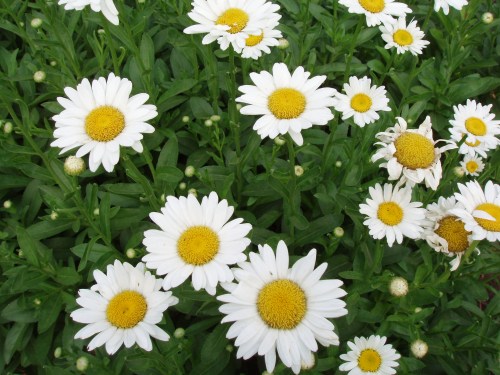
Shasta Daisies

Shasta Daisy - I think this variety is "Alaska"

Tall Garden Phlox –Daylilies – Zinnias – Cosmos

We’ll visit each of these over the summer

But this week let’s begin at the top of the list.

Gloriosa Daisies (Rudbeckia) are like sunshine. 

Glorious Gloriosa Daisy

Their bright sunny faces start appearing in June and will continue till fall if deadheaded.

As with most flowers the first blush of the season is the biggest and boldest.

You can start them in your garden with seeds or with plants.

There are many varieties – some solid yellow some with brown centers.

The only variety I’m not crazy about is Goldstrum Rudbeckia.

I like the flower OK, but it’s growth habit is a problem for me.

Within the first year or two it will form a large dense clump.

Th kind of clump you think of with major shrubs. 

It’s a big too aggressive for the average backyard garden.

If you have a field to cover then be my guest.

Gloriosa patches have planted themselves here and there throughout my garden.

Some are short with small blooms.

Others are bigger and bolder.

Since many of my garden plants are pass along plants I don’t know many variety names.

Sorry.

My first Gloriosa’s came from my friend Sally early one December.

A backhoe was in her garden and she lifted plants as quickly as she could rescue them.

I was the lucky recipient.

She had gotten them from her mother’s garden.

Gloriosas are especially pretty in early June next to purple Larkspur.

Gloriosas and Larkspur

Nature has a wonderful sense of color that way – arranging for complementary colors to bloom at the same time – such wisdom.

So plant them in full sun and they’ll reward you each year.

They’ll even make babies if the last seed heads are left on in the fall.

Purple Coneflower (Echinacea) has much in common with Gloriosas.

They both have a daisy like flower.

They like sun – though Echinacea will also do well in part shade.

They will rebloom if deadheaded through the summer.

And make babies from seed pods left alone late in the season.

They also make patches of color in the June garden.

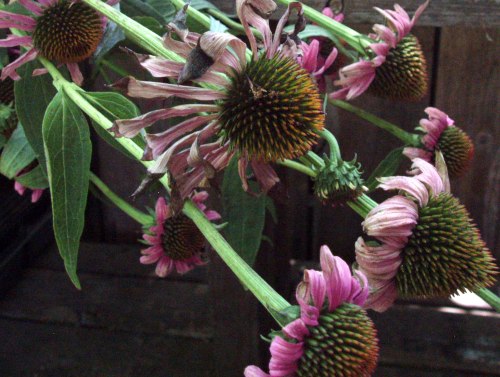
The petals of Echinacea begin life standing straight out.

Newly opened Echinacea blossoms

After a day or two they begin to droop.

Just a fun addition to their personality.

Shasta Daisies belong in this group.

Bright open flowers.

Straight stems.

Same self seeding habit.

Lover of sun.

Debra captured this bee visiting a sunny Shasta Daisy

You can divide Shastas by dividing the clump in spring or fall.

Or from deadheads dropped along the way.

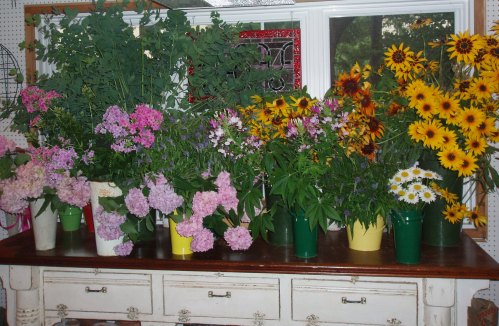
Because these flowers produce lots of blooms they are great for cutting.

Buckets of flowers cut from my garden waiting to be arranged.

Flower arrangements summer 2010 - ready to party!

You’ll still have many left even after making the biggest arrangement imaginable.

Summer arrangement June 2010

Cutting instructions are almost the same for all three.

Cut when the petals are open, but the center disk is tight.

Condition for several hours or overnight beginning with slightly warm water.

Strip the foliage off Echinacea and Shasta’s.

Leave it on for Gloriosas and also split the bottom of these stems about an inch or two.

You can do the same to the others if the stems are old and woody.

Gloriosa’s can be a bit picky and wilt down easily.

I find that it’s best to cut them at the joint rather than cutting so long with several branches jointing out.

I don’t remember this every time and have killed a few along the way.

So there you have it.

Three great choices for the “dog days of summer”.

Enjoy!

Gail

Summer's "Dog Days" flowers in full bloom

3 Comments

Filed under Gloriosa Daisy - Rudbeckia, Purple Coneflower - Echinacea, Shasta Daisy, Uncategorized

WEDDING ZINNIAS

Kelly's field of Wedding Zinnias

There’s a small “tradition” in this neighborhood.

Wedding zinnias.

We grow them for wedding amongst other things.

It started seven years ago

Elliott and Kristina were marrying that June.

We wanted to grow as many wedding flowers as possible.

Kristina’s mother Mary brought cut hosta leaves from her Wisconsin garden.

Mary's hosta leave in Kristina's bouquet

A dozen friends gave the florist “cutting rights” the week of the wedding.

My friend Kelly had a few empty beds in her orchard.

She offered to plant them to zinnias.

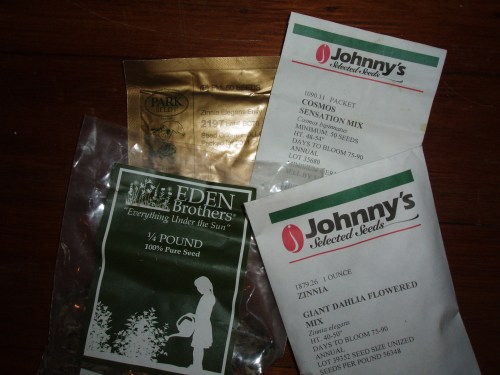
I ordered zinnia seeds.

In bulk. 

Waaaaay to  many seeds.

Since the wedding was mid June we started planting early – mid April.

Kelly tilled up the soil and we sprinkled seeds.

Everywhere.

Soon we had a great crop of baby zinnias.

They would grow into a small field.

The perfect backdrop for Kristina and friends at her bridesmaid luncheon.

Kristina - Friends - Zinnias

For their intended use at the rehearsal dinner.

Rehearsal Dinner Arrangement

And back up flowers when the wedding was moved into the church after lots of rain.

Last minuet pew arrangement - thank you Ryan!!


They continued to bloom throughout the season.

By the end of the summer Kelly had cut buckets and buckets of zinnias.

She had done an entire wedding of zinnias for another friend.

Florists, neighbors and anyone with scissors and a bucket of water took home zinnias.

It was a splendid summer.

Now it’s my turn.

My friend Cheri’s daughter Anne is getting married late summer.

She wants purple zinnias.

So Cheri ordered in bulk.

She’s planting lots at her house.

I’m planting at my house too.

Remember last week when I talked about weeding and thinning my way through the garden.

I’ve been working on that process.

Removing and cutting back early spring flowers that are spent.

This makes little empty places all through my garden.

Once they are cleared I work up the soil and sprinkle in zinnia seeds.

I’ll use my favorite mix and add Cheri’s purple seeds.

Spread soil back over the area.

Tamp it down.

Give it a drink with a soft spray

There you have it.

In a week or two you’ll begin to see summer’s glory.

Just remember to keep the area moist so the seeds can sprout.

Now since my garden is mostly perennials I can’t plant a field of zinnia.

But I can find lots of little spots for a few seeds.

Zinnias love the heat

They’ll give you patches of color all over the place.

Bright color.

The kind that will take the summer heat.

I’ve also planted cosmos in the same way.

At the same time.

But I must confess.

I can’t seem to grow Cosmos in this garden.

Don’t ask me why.

A mystery.

But…I keep trying.

So, I’ll sprinkle cosmos along with the zinnia.

A little planning and planting this month will give you flowers well into the fall.

You have a big window of planting opportunity.

Actually you can plant these seeds as early as mid April and continue on through the 4th of July.

I never seem to have the time or space until about now.

I clip packages of seeds to my calendar every week or so to remind me to keep planting.

This plan will give you color and cut flowers throughout most of the growing season.

Zinnias just seem to make people smile.

What more could we ask for.

Happy Anniversary Elliott and Kristina.

Gail


10 Comments

Filed under Cosmos, Uncategorized, Wedding Flowers, Zinnia

OLD SOLES

My original red garden clogs

Twenty plus years ago my friend Debra gave me a pair of garden clogs.

They have red soles.

Not the red soles that a certain designer now temps us with.

No these were red plastic from their turned up toes to their elevated heels.

Molded plastic.

Not very stylish.

But oh so practical.

They were platforms before we knew platforms.

Keeping my feet high and dry.

Transporting me through the wet grass on my early morning walks to see what’s new in the garden.

They are among the first “garden tools” I owned and have graced the back door at both homes where I have gardened.

Various dogs have chewed on them along the way.

Their cork and burlap insoles were molded to fit the shoe.

Over time they have simply disintegrated.

I’ve looked for replacement soles to no avail.

So now it is time for them to retire.

They have been replaced with a sunny pair of lime green clogs.

Old "sole" friends and new.

Softer

Not as tall

But comfy

On to the next quarter century!

This week has been hot.

Unusually so for the first week of June.

This is when a healthy perennial garden really shines.

First of all it’s June.

And like the old song says “June is bustin out all over”.

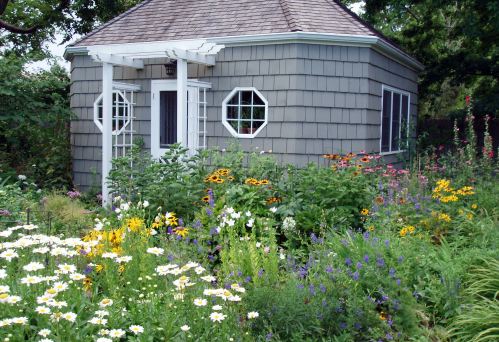
Stella d' Ora Daylillies, Larkspur and the Garden House

The larkspur is the color backdrop in my garden these days.

With its self-seeding nature it lays curtains for small vignettes of color play.

Gloriosa Daisies and Larkspur

My before mentioned friend Debra visited this week and brought along her trusty camera.

You’ll notice an improved quality to many of the pictures this week.

They are hers.

Poppy pods and Asiatic Lilies

The truth is my garden is a little out of control.

For some reason I’m behind where I usually am.

No real reason.

No excuse.

Just behind.

My normal ritual once all the planting is complete is to begin at one end of the garden and weed and thin my way to the other.

Not this year.

No focus.

I go into the garden and just flit about.

A little staking here

A little pruning there.

Then there were all those evening spent picking strawberries and snap peas.

So…I must get back to my routine.

To begin this sweep of the garden I usually take along my wheelbarrow, pruners, wicked EZ digger, and a bucket of some sort for weeds.

Pruners and EZ Digger

Then I start at the west end and

Deadhead

Pull weeds

Thin volunteer plants

Clean out around the rose bushes

And generally whack away at anything that is too big or having problems.

This week it was two Aloha rose bushes.

They have had some bug on them every year for the past several years.

This nasty little guy eats the center of each and every bud.

From my reading I think it’s thrip.

I’ve tried organic control.

And I must confess some not so organic controls

Nothing works for very long.

So I just decided I’d cut it back to a foot or two from the ground and see what happens.

I’m not getting any roses from it now so how can it hurt.

I did this earlier in the spring with the rose on the arbor to the garden house.

It’s coming back nicely.

Arbor rose revived.

So far disease free.

As long as I’m confessing to using a few chemicals I might as well come completely clean.

There are two problems that I have read simply cannot be fixed organically.

Bind weed grows roots so deep that it cannot be dug out.

Bind weed growing through the deck!!!

It comes back from the center of the earth every time.

I’ve tried spraying it with vinegar .

No luck.

Nut grass is the other.

No such thing as a pretty picture of nutgrass.

If you pull it out – even in very loose soil – there is a little bulb underground that explodes with the force of being pulled up.

When it explodes it makes babies.

More nut grass appears within what seems like seconds.

Sometimes nature really tries my patience.

So in these two instances I am now confessing to using Round Up.

I’m not proud of it.

It’s the only control I’ve found.

Even then it can take more than one round to kill it out.

And…chances are both of these little demons will appear again.

Let’s end on a positive note.

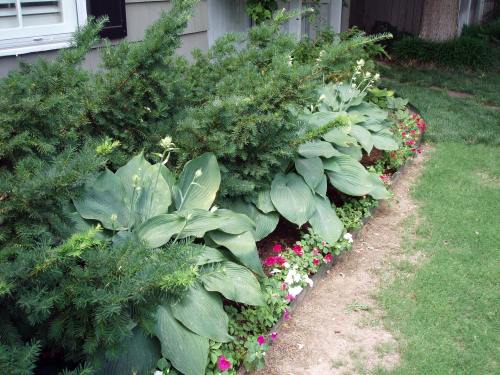
Three years ago I planted Bressingham Blue hosta in my front bed.

Bressingham Blue Hosta and Impatiens

They have loved it there.

This year they have gotten so big that they are shading out the Impatiens planted along the edge of the bed.

So…a little pruning was required.

I cut off the front leaves to let in a little sunlight.

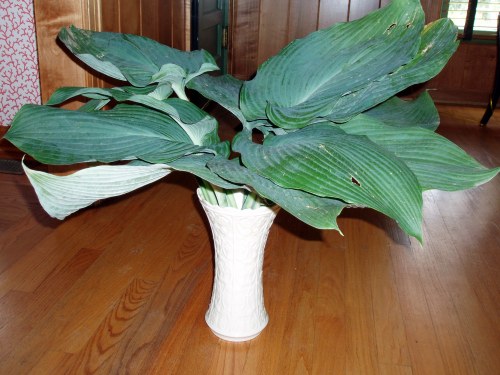
They were simply too gorgeous to compost.

So I brought them inside and put them in a vase that had belonged to my mother in law.

We’ve been enjoying this unusual and breathtaking arrangement all week.

Hosta leaves in Geraldine's vase.

It will likely last another.

Remember to drop by your local farmers market this weekend.

Enjoy the week in your garden.

Gail


1 Comment

Filed under bind weed, Gloriosa Daisy, Hosta, Larkspur, nutgrass, tools, Uncategorized

MURDER IN THE GARDEN

You may remember earlier this spring I talked about wanting to learn more about
growing vegetables.

Working them into my existing perennial beds.

I decided that this was the year I would focus on Sugar Snap Peas.

See if I could improve on the yield.

I got them in right on time and they have rewarded me.

Looks like a good crop. 

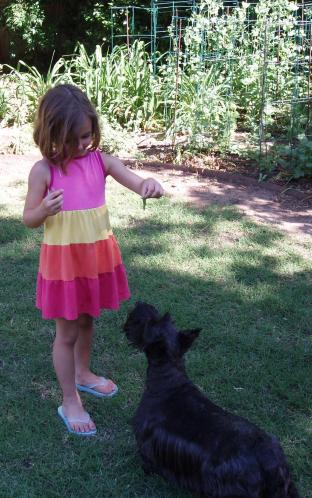
Then just last week I reported that Peg, our Scottie, likes them.

It was even cute that John and Cassidy were feeding them to her.

It’s not cute anymore.

Earlier this week I was out picking a few peas when I heard a snap behind me.

Peg was helping herself.

I scolded her and went on about my evening.

When I went to the garden the next morning an entire row of peas had been
well…murdered!

Peg in her zest to “eat local” had tromped down and munched through the row.

She promptly started on the next row.

We even caught her with pea stems hanging out of her mouth.

Horrors!

Well the whole area has now been fenced.

And re-fenced since she has broken in a couple of times.

I stopped just short of razor wire.

I’m sure she has fence marks all over her nose from breaking in.

So far the fencing is holding.

Hopefully I can outwit a Scottish Terrier!!!


The beginning of June is a glorious time in my garden.

The larkspur continues with its vivid purple.

It’s complemented by the gold of Stella d’ Ora miniature day lilies.

Asiatic Lilies begin to bloom.


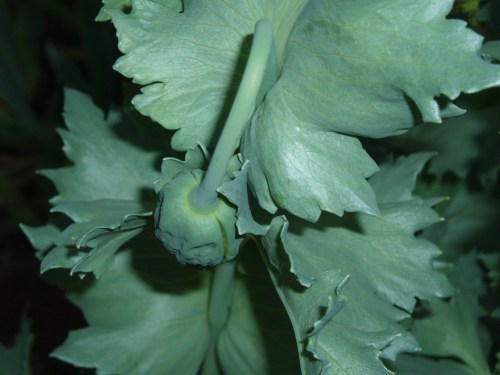
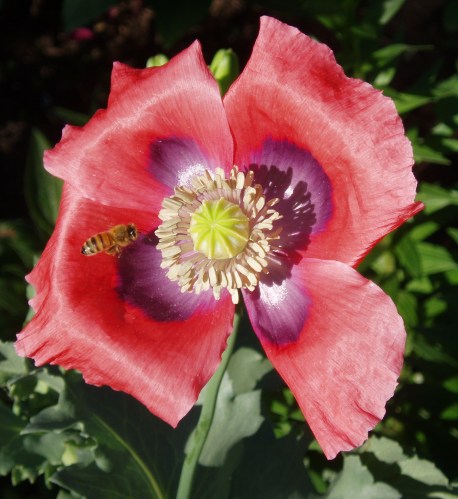
Poppies are opening up here and there.

They are interesting at all stages.

From their droopy buds

To their short-lived blooms

To their seed pods left to dry out and reseed for the next year.

Self-seeding annuals provide a lot of fill-in flowers in my garden.

As well as tons of cutting potential.

A self-seeding annual is a flower that if left to mature ie. dry out in the
garden will drop seeds and make lots of babies next year.

So even though the plant does not make it through the winter you will likely have
that type of plant in your garden each year.

You just never know where they will pop up.

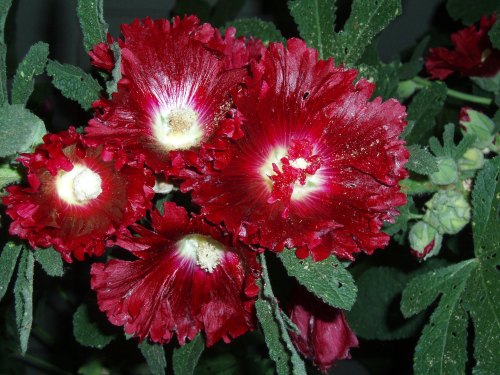
The flowers that self-seed in my garden are Columbine, Poppies, Larkspur, Hollyhock,
Cleome and Cockscomb.

Hollyhocks

I also get a few Zinnias.

Now…this  sounds like a good deal.

And it is…to a point.

Free seeds.

No planting.

But you have absolutely no control over when they come up.

Or where they come up.

Or how many come up.

And because I compost the old plants at the end of their lives I end up with plants

EVERYWHERE!!!

This is most true of Cleome and Cockscomb.

They lay a carpet of seedlings.

There comes a time when some of them have to go.

Yes, friends, Peg is not the only murderess at our house.

I’ll spend the week pulling up and composting thousands of baby plants.

So how do I decide who lives and who dies?

There are a few bits of logic to apply here.

Since both Cleome and Cockscomb will get about shoulder high I will start at the
front of the garden.

Everything within the first foot of the edge should go.

Now, I do this every year but somehow they find their way back.

Next I’ll make sure that they are not growing up in the middle of other plants –
like rose bushes and tomatoes.

Then I’ll pull them up from the middle of the paths.

Cockscomb and Cleome gone wild in path

And finally I’ll go into the open areas and thin away.

A few years back I thought I’d just let them all live and see what happens.

Not a good idea.

They are so crowded that nothing really matures and comes into its own.

So…it has to be done.

Come fall I’ll be glad. 

My garden will turn from the pales of early spring

To the hot colors of the heat of summer

Followed by the richness of fall.

Cockscomb will come fully into its own.

Fall flower arrangement with cockscomb

But I’m getting ahead of myself.

For now I’ll just thin.

Knowing that it’s the best thing for everyone.

Gail


1 Comment

Filed under cleome, cockscomb, Columbne, hollyhocks, self seeding annuals

GARDEN MENTORS

One of the interesting things about gardening for me is how we learn.

For the most part the knowledge is handed down from one generation to another.

It’s informal.

Passed over garden fences.

Or we just watch.

Ask questions.

I learned about gardens from a series of wonderful women in my life.

It began as most things do….

With my mother.

Mom among her roses. Judging by the hair I'm thinking 60's - 70's?

Mother was not a detail person.

She painted with a broad brush…

I learned that lesson well.

She was fearless when it came to much of life.

She would try to grow anything and lots of it.

So though I cannot attribute exact knowledge to her, she is critical to how I garden.

That I garden.

She gave me gumption…for gardening….for life.


Her mother – Grandma also gardened.

Pat's photo of Grandma circa 1960's

I have very specific memories of a most fragrant rose-bush by her door.

Variety unknown.

I never plant a rose that isn’t loaded with fragrance.

There was also a Bridal Veil Spirea on the west side of her house that would bloom near Memorial Day each year. 

Grandma in front of her bank of Bridal Veil Spirea

And Irises.

But mostly there was the wash-house.

In the summers she gave it over to my sisters, our cousins and me for a play house.

So many memories of little girls making up stories.

Dressing up.

It is the inspiration for my own garden house.

My current “play house”.


If your lucky women who love gardens and nature keep coming into your life.

I was.

My mother-in-law, Geraldine had grown up in Arkansas during the Depression and knew how to grow everything.  


"Grammy" and Elliott


She was more attentive to details….small things.

From her I learned to look closely.

To take it in slowly.

She could propagate anything and everything.

Simply put it in a jar of water and roots would sprout.

Unfortunately, I didn’t ask her to teach me that before she died.

Wish I had been paying more attention.


Then when Elliott was about 3 we moved next door to a gracious woman named Geraldine. 

 Imagine 4 women…2 named Geraldine!

Geraldine circa 1980'2

Each spring I would drive her to the nursery.

I would watch how she shopped.

With perennials always buy 3….never 1.

Make sure you have lots of variety.

And New England Aster – the fall blooming ones that come on just before mums.

Those were a favorite of hers and now mine.

She was gracious to her fingertips answering endless questions and taking us into her heart.


All of these women are gone now.

But they live on in my garden and in me.

On this Memorial Day weekend I thank them.

I remember them.


So…what happened in my garden this week.

Mostly, it rained!

Thankfully.

But here and there I snuck in a bit of gardening.

Cassidy and I planted Mammoth Sunflowers.


If they haven’t washed away they should sprout and grown to 7 or 8 feet tall.

They’ll be peaking their sunny faces over the fence later on in the summer.

More deadheading of the New Dawn roses along the fence.

I’m finally putting my basil babies in the ground since the nights are consistently over 50 degrees. 

This is much later than usual.

Since most shady perennials are finished blooming sometime in June I tuck impatiens in here and there in the shady areas of my garden.

Hostas and Impatiens for summer color.


This will give bright spots of color for the rest of the season.

I also plant any caladiums that I dug last fall.

They always seem to shrink over the winter so we’ll see how that goes.

But mostly this week I’ve enjoyed my garden.

The larkspur and poppies are blooming at random as is their self seeding nature.

The strawberries are coming on strong.

Time to bake tiny strawberries pies in my mother’s harvest pie pans.

 The neighbor’s mulberry tree is dropping mulberries into our yard which I love.

It’s a trip back to my childhood.

I know they are messy but there is nothing as wonderful as picking mulberries off the tree and eating them as fast as you can pick.

I introduced Cassidy to this tradition and she agrees.

Unfortunately, I also mentioned to her that Peg loves fresh snap peas.

She and John have fed Peg most of the crop so far.


So Mom, Grandma, Geraldine and Geraldine your love of gardens and gardening lives on in me and in the next generation with Elliott and Kristina.

We are passing it along to the neighbors…over the fence.


Gail


5 Comments

Filed under Basil, Gardening Mentors, Impatiens, roses, Strawberries, sugar snap peas

HYDRANGEAS WONDERFUL HYDRANGEAS!


I don’t actually remember when I fell in love with hydrangeas.

It was likely from a magazine picture years ago.

But the real romance began when I first visited Martha’s Vineyard.

The relationship was sealed on my last visit to Cape Cod.

Of course, they are blue in the sandy soil and salty air of the “Cape”.

Mine on the other hand live in an alkaline home and are pink for the most part turning to green in the fall.

Endless Summer Hydrangeas June - 2010


To my way of thinking the Hydrangeas give you more flowers over the course of a growing season than any other plant.

I know – that’s a pretty bold statement.

But since I finally have the right home for them they have rewarded me beyond my wildest dreams.

It all depends on several things.

First you have to get the right kind of hydrangeas.

The old H. macrophylla are wonderful. 

But in our climate where spring can come early and tease those precious buds along, only to be clobbered by a late freeze – they are risky at best!

So, I’ve become a big fan of a variety of H. macrophylla called Endless Summer.

They named it right.

About 5 years ago I planted them across the front of my house and also just inside the backyard gate. 

Hydrangea - Caladium - Impatiens at gate

I was patient – knowing it takes at least 3 years for them to hit their stride. 

Then the pine tree that provided them shade for part of the day succumbed to pine needle blight.

They were left in total sunshine.

I panicked but had no place to move them.

So… I dripped water on them a little more than usual till they got established.

I treated them a bit like roses in that I put a ring of manure around them a couple of times each summer.

Then I would protect the crown for the winter with a big dose of in the fall.

They have rewarded me for my attention and bloomed well…endlessly!

Last summer they were simply breathtaking. 

Truly Endless Summer

OK….that sounds like I’m bragging but the truth is I have had very little to do with it. 

These guys know how to grow and bloom.

So…here’s the formula that’s worked for me.

Buy a reblooming variety – Endless Summer in the blue bucket is my favorite.

There is also a sibling of Endless Summer called Blushing Bride.

It’s white with a faint pink edge.

Site it well. 

They do need some sunshine to really bloom well.

Morning sun and afternoon shade is perfect.

Use drip irrigation to soak it deeply.

Feed it manure.

Give them time to reach maturity and …..

Resist cutting them back until very late in the spring after every branch has had a chance to green up.

Enjoy!

Mine are just beginning to bloom so I’ve included pictures from last year when they were in full glorious bloom.

Hydrangeas connect  people.

Seven years ago when Elliott and Kristina married I didn’t have one hydrangea bush.

But my friend Martie did – all across the front of her house.

And she was generous enough to let the florist cut away.

Now she always remembers their anniversary reminding me just this week of that fun adventure.

So, once you have them going at your house I know you will want to spread the joy around and share.

Debra's picture of cut Hydrangea

Seriously, if you find room for 6 or 8 you’ll be cutting arm loads of blooms just like Martha does on TV!!!

Even one or two will give you dozens of blooms.

They do require a little bit of special treatment to insure the cut blooms last a long time.

Here’s how. 

When you go to the garden to cut take either a BBQ type lighter or a container of very hot water.

Cut flowers that are fully open and have been in bloom for a few days.

You can cut the stems long – all the way to the main branch – or short depending on your need.

Remove most of the foliage.

Make a slit in the bottom of the stem for an inch or so.

Then either dip the bottom of the stem in the hot water or singe it with the lighter for a few seconds.

Put them in a container of water up to their necks to condition for several hours or overnight.

Now…I know that sounds complicated but once you get the hang of it you’ll be glad you did because they will last for days or even a week or two.

I tested this last summer when I cut hydrangeas on a Wednesday and took them to Colorado for my nephew’s wedding.

Cut Hydrangea ready for arranging.

Ten days later Kristina and I and her friends made them into arrangements for the big day.

These instructions come from a book my mother gave me in 1997.

Tools for glorious Hydrangea arrangements.

It’s called “A Garden For Cutting” by Margaret Parke.

In the back it gives excellent instructions for cutting, conditioning or drying all every kind of fresh flowers.

If you want a cutting garden add this book to your library.

Thanks, Mom!

And…once you have them cut and conditioned…they practically arrange themselves.

Vases of Hydrangea and Roses


In late summer they turn to a lime green - yummy!

Gardeners love to share their gardens.

To share plants – it’s called “pass along plants”.

And seeds.

And the bounty of our gardens.

But most of all I like having people come and visit my garden.

This week my neighbor Lish invited friends from out of town to come and see her garden as well as our friend and neighbor Sally’s garden and then mine. 

Then we had lunch in the garden house.

Margaret - Robin - Lish - Barbara - Suzanne - Sally

What joy!

Hope you have many hours in your garden.

If you don’t have one…visit a friends.

Gail


2 Comments

Filed under Gardening Friends, Hydrangea, Uncategorized

CATCHING UP

CATCHING UP

Perhaps it’s time for a little catching up.

A review of where I am this spring.

Remember the roses that froze to the ground last winter?

Well, they are doing quite well and….

They are still pink!

The roses and peonies were in full glorious bloom last week when we had an unfortunate few days of mid to high 90 degree weather – with wind.

As it happens some years, the bloom life of these glorious spring standards was shortened.

I hate it when that happens.

But it’s a fact of gardening life.

So…I’ll begin dead-heading a bit earlier than usual.

Dead-heading?

Sounds like a rock band doesn’t it!

It’s actually one of the most important things I do to keep my garden blooming all season.

Dead-heading is simple.

It’s removing the spent blooms of plants so that they can begin the bloom cycle again.

Now…not every plant will re-bloom.

Peonies for instance do not.  So you just remove the stems of the spent blooms to tidy them up a bit and leave them be for the rest of the season.

I don’t usually cut mine back to the ground until the next spring when new growth appears.

Iris both German Bearded and Dutch also should also have their bloom stems cut back as far as possible once the last buds have bloomed.

Spent bloom stems of German Bearded Iris waiting to be dead headed.

But…leave the greenery to die back on it’s own.

We’ll fiddle with them a bit more later on in the season.


Many roses on the other hand will repeat bloom if you deadhead.

Hybrid tea roses and any old-fashioned rose that is remonant or repeat bloomers will give you more flowers.

To dead head them cut off the spent bloom to at least the first set of 5 leaves.

If the rose-bush needs shaping you can cut them even further down the cane.

Pink Belinda's Dream rejuvenated and ready for dead heading.


That’s it – no big mystery here.

For me it’s kind of a zen experience.

Doesn’t require loads of concentration so you can lose yourself in this bit of gardening.

And…you’ll be rewarded with new buds and blooms within a few weeks.

Now, the spring flush is by far the most breathtaking but the scattered blooms throughout the season bring me great joy.


Then there are things that I don’t dead head.

I want them to go to seed.

Digitalis or Foxglove are among them. 

Digitalis


I’ve worked hard to get them going in my garden and I want them to spread so I’m restraining myself from cutting any for a few more years.

Hopefully someday I’ll have patches of their amazing towers of bell-shaped blooms all over the place.

A closer look.

Columbine is a mix of these methods.

The more you cut it the more it blooms.

But at some point usually when it starts to warm up I quit cutting and let it go to seed.

Once the seed heads have dried up – late June or so – I’ll pick them and scatter them in shady areas.

It’s worked pretty well in my loamy soil and I have new columbine babies each year.

Self seeded Columbine by the garden bench.

I’ll give more deadheading instructions as the season goes along.


Other activity includes finally planting my Caladium and Elephant Ear bulbs.

I’m a little behind on those but better a little late than too early with bulbs.

Remember – both of these like to be planted in the shade though their faces can extend into the sunshine.

The basic rule with any bulb is to plant them as deep as the bulb itself.

Not a big deal for Caladiums,

But…you’ll have to dig a BIG hole for the Elephant Ears!

Both will have to be dug in the fall here in zone 7.

Since we are expecting a week of glorious low 70’s weather I think I’m going to finally transplant a Blushing Bride Hydrangea to a new roomier home – got a little carried away with my purchasing a few springs ago – no big surprise.

This morning Pam cut flowers and made them into bunches to sell at the Farmer’s Market tomorrow.

I’ve added some herbs – Rosemary, Sage and Mojito Mint along with bags of mixed lettuce.

So drop by the coop table at Grand & Garriott between 8 & 11.

 Flowers, herbs and lettuce ready for Saturday's market.

Last weekend I spent time with Elliott and Kristina in their garden.

We planted new Dahlias – one of Kristina’s favorite, set out tomatoes and peppers and put out Lady Bugs.

Giving lady bugs a new home.


But mostly we simply enjoyed being in their garden, having meals in the garden, talking about gardening and visiting the nursery. 

As Elliott was growing up I sometimes wondered what part of that experience he would take with him into his adult life.

Although he didn’t really garden much then he was constantly exposed to this need to dig in the soil and grow things in our home and with both sets of grandparents.

It stuck.

He is drawn to the earth.

I am thankful.

Enjoy this glorious weather.

Gail


2 Comments

Filed under Columbne, Dead Heading, Digitalis, Farmer's Market, Gardening;Perennials, Peonies, roses

PATIENCE


Gardening is a teacher – a kind of life coach – before we knew they existed.

If you listen to the pace of nature you will learn.

Not just about gardening but about life.

It will teach you to be more observant of details.

To appreciate small miracles and big surprises.

But most of all it will teach you patience.

Garden View Year 1


There is a saying about perennials.

 The first year they sleep.

The second they creep.

And the third they leap.

It’s true.

There is really very little you can do to move them along.

So we must simply learn to be patient.

In time you will realize that the years have gone by and your garden is full if not overflowing with growth that you have nurtured.

A few patient years later.

There are however things that you can do to help the process along.

Take the time in the beginning to prepare the soil well.

We’ve talked about this before.

Add compost, chopped leaves, manure and a little peat moss to make sure that you create a place where plants truly can grow.

I continue to add these things to keep the soil rich but the beginning of life of a garden is when you can really do the best job of building a good home. 

Next comes your chosen method of watering.

Now, I know this is not nearly as much fun as buying and planting but it is important for many reasons.

All of us should be continually aware of our water consumption – no matter how high the water table and how easy it is to get your own well.

Water is in short supply on this planet. 

Using it wisely is simply the only responsible choice.
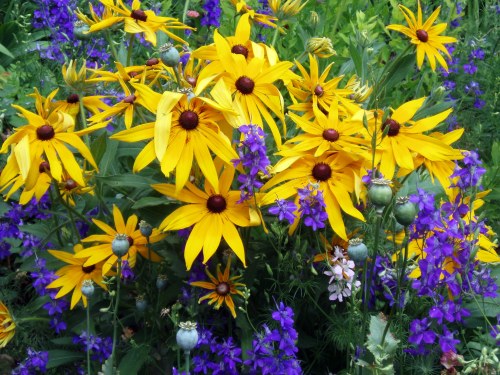
That is the moral reason why I love drip irrigation systems.

But the truth is it’s really great for the plants as well.

Not to mention how easy it is to use.

You may have noticed black hoses in some of my previous pictures.

Emitter hoses in front bed.

That is my wonderful drip system. 

It runs throughout my garden and makes it unbelievably simple to water then entire garden.

I simply lift the handle on two faucets and walk away.

Here’s how it works.

The black hoses are ½” tubing with emitters inside the hose.

You can order them with 9”, 12” or 18” spacing. 

Your other choice is ½ gallon per hour or 1 GPH.

As I recall mine have 12” spacing with 1GPH.

The entire system comes from a company called Dripworks.

Unfortunately, it is not sold at retail in this part of the country, but can be ordered online at www.dripworks.com.

The kindly people there will even help you design your system and figure out how much emitter tubing you need and additional fittings, etc.

After laying more feet of this than I care to admit, John completed the project.

A four-way splitter was attached to the faucet. 

Then he put female fittings at the end of each section of emitter tubing.

The ends were then capped.

There you have it.

A big backyard perennial garden watered deeply – completely by turning on two faucets. 

What geniuses these people are.

And the best part.

The water goes into the ground – not evaporated into the air.

Or on the leaves of the plants where it would only encourage nasty fungal diseases.

Everyone wins – you gotta love that!

But remember – this is a slow drip.

You want it to water over a period of time.

Overnight in the case of my large beds.

So you have to be patient.

Just barely turn it on – a slow drip that waters deeply drawing the roots deeper into the ground where they will more readily survive the drama of today’s unpredictable weather.

Remember the week in early February where we went from -4 to 80 degrees!

Deeply rooted plants will take that kind of torture and the extreme heat that is sure to come this summer.

The other important thing to remember about drip irrigation is you don’t water as often. 

In an average year I only water my big perennial bed about once a week during the growing season.

After all the water is going where it is needed so you don’t have stand there and spritz it a little every day.

Patience…a quality that comes naturally to some and is a lifetime struggle for others.

With gardens it’s worth – shall we say – “cultivating” this quality!!!

So…this week stroll through nature.

Take it all in, patiently.

Gail

Leave a comment

Filed under drip irrigation, Gardening;Perennials, patience

COHABITING

When I began to garden my mission was to grow flowers to cut and arrange and give away.

That is still a major goal.

But bit by bit I began to want to grow vegetables.

The layout of my garden does not lend itself to rows of lettuce and tomatoes.

It’s more of a winding, flowing kind of place.

Tomatoes and peppers were easy to figure out.

You just treat them like any other flower plant.

Find a sunny spot and make it their home.     

But after a few years of that I wanted more.
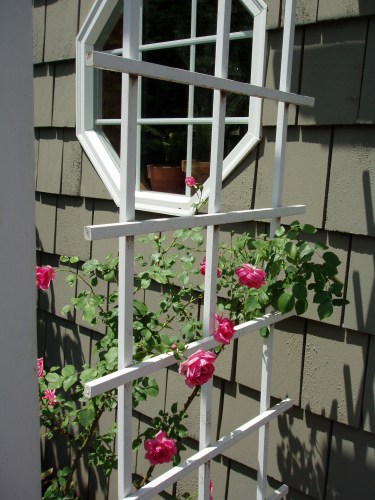
So…I had to improvise.

Luckily gardeners are pretty good at this.

My first thought was to edge portions of flower beds in lettuce.

Lettuce is a cool season crop which means we get an early crop and a late crop in our climate.

So early in February I rack the leaves away from the edge and sprinkle lettuce seeds.

Most of the time I used a seed mix called Encore from Johnny’s Selected Seeds.

Sprinkle some of the soil back over – give it a gentle pat and a little drink and wait.

Keep it evenly moist till it begins to sprout.

By April you’ll have a green garden edge.

What fun for you and the bunnies!

Just plan enough for everyone.

Then as it begins to warm I fill in the gaps with the summer resident – impatiens.

Peg "helped" me cut away the dead from the hydrangea bushes


Then we added Impatiens to the lettuce edge.

You see in the summer this space will be considerably shadier so it’s home to

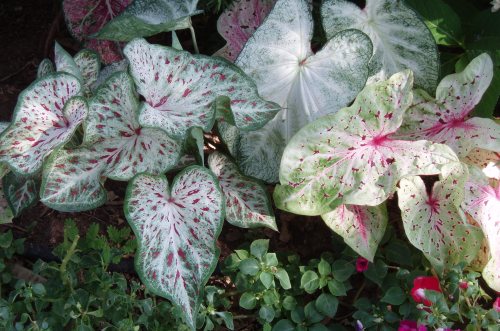
a bed of Yew, Hydrangeas, Caladiums and Impatiens.

If I’m really industrious come fall after the first cold blast I’ll dig the Caladiums, pull the Impatiens and plant a fall and winter crop of lettuce. 

It will come up anytime between November and February – depending on when I get it done and what kind of winter weather we enjoy!

Next I decided that the cages that house those glorious late summer and fall Dahlias were just idle in the spring.

Can’t have that.

So…they also get an early leaf removal in February.

Sugar Snap Peas are the crop of choice for this location. 

Super Sugar Snap Peas growing up Dahlia cages.

It could also be used for Green Beans. 

Really anything that needs something to climb on that is an early cool season crop will work.

Then I decided that I was tired of weeding the area behind my bank of Hydrangeas in the front yard.

I don’t mind weeding – it’s part of the deal after all.

But…I am always working to reduce the time I spend weeding.

Now this is going to be confusing but here goes.

When I say Hydrangea you are likely thinking it’s a shady area.

It was when we planted the Hydrangea.

Then the pine tree shading it from far overhead fell victim to the blight that is unfortunately taking out so many pine trees.

I was left with a sunny Hydrangea bed.

Perfect for a ground cover of Strawberries.

My sister Ann gave me some starts from her plants and we were off.

Going into the front and picking a handful of strawberries for your morning cup of yogurt is a spectacular way to start the day.

Now…these are not those over sexed things you see in the grocery stores.

No, these are real strawberries – small – tart – juicy – yummy!

I’ve since added strawberries under the forsythia in the back and am always on the lookout for another sunny spot that needs groundcover.

Strawberries growing under Forsythia.

So look around your yard and see if you can find a home for vegetables and berries.

This weeks two friends helped me both with this blog and in my garden.

You’ll notice a new picture at the top of my blog.

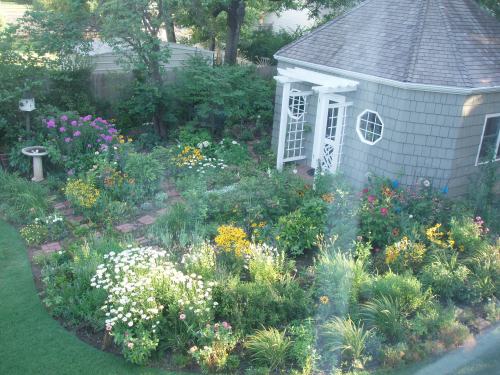
It’s a wonderful shot of my gardenhouse taken by my dear friend Debra.

Her medically trained radiologist eye sees the world in sweeping landscapes and infinite details.

Her pictures record her story intertwined with those of us fortunate enough to be her friend.

Thanks, Debra.

And a new friend Alyssa visited for a day to help and learn.

She’s an intern with my sisters at their retreat center Turtle Rock Farms.

I loved having the help and companionship for the day.

Alyssa in a sea of Katy Road Pink Roses

And to close, a sincere thank you to everyone who has told me they enjoy reading my weekly ramblings.

Hope you’ll think outside the gardening box. 

It’s a great place to live.

Gail

3 Comments

Filed under Uncategorized